
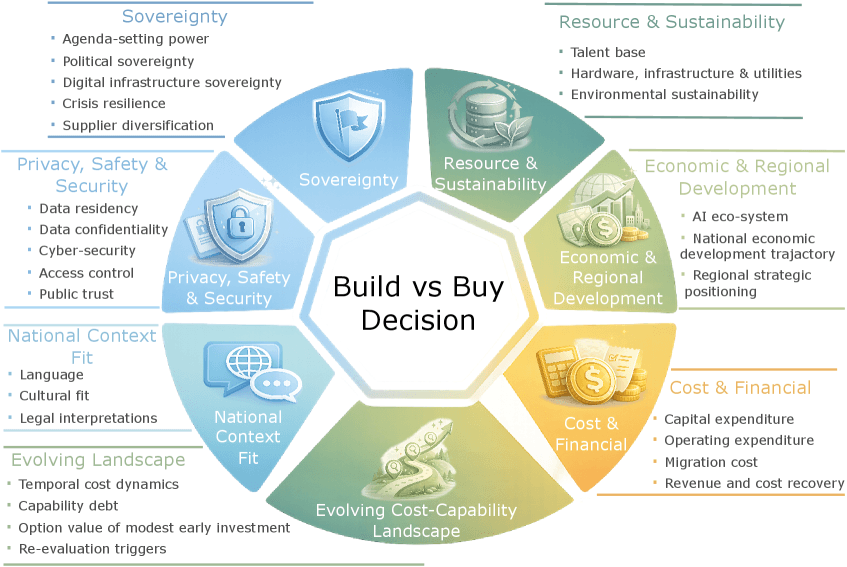
Your AI Buy vs. Build Checklist: Stop Wasting Money on the Wrong Choice
You’re ready to use AI. You have a project in mind. Now you face a critical, expensive question: Do you buy a ready-made service or build your own solution?
Get it wrong, and you risk data leaks, vendor lock-in, or blowing your budget on unnecessary tech.
Get it right, and you move fast on safe ground while protecting what matters most.
Research from leading institutions provides a clear path forward. It’s not about a one-size-fits-all policy. It’s about matching the right approach to each specific need. This article gives you the exact framework to do that.
What Researchers Discovered: It's a Choice, Not a Mandate
A team of researchers analyzed the high-stakes decision governments face with large language models (LLMs). Their findings apply directly to any large organization. You can read the full paper here: Buy versus Build an LLM: A Decision Framework for Governments.
They found there is no single right answer. The best choice depends entirely on your specific use case.
Think of it like this: you wouldn't use the same strategy for buying office coffee (buy) as you would for developing your secret product formula (build). You shouldn't use the same AI strategy for a public chatbot and for analyzing your most sensitive customer data.
The core insight is a decision framework based on three key factors:
- Data Sensitivity: How private or regulated is your data?
- Need for Control: Do you need perfect control over how the AI behaves and what it says?
- Strategic Importance: Is this task a core part of your competitive advantage?
Low scores across these factors mean buying is likely safe and efficient. High scores signal you need to consider building or a heavily secured hybrid approach. Trying to force every project into a "buy everything" or "build everything" box is a recipe for wasted money and created risk.

The most effective strategy is often a hybrid one. You use bought services for non-critical tasks to move fast. You invest in building or heavily securing solutions for your "crown jewel" applications. This balances speed, cost, and security.
How to Apply This Framework Today (Your Action Plan)
This isn't just theory. You can use this framework this week to audit your current or planned AI projects. Follow these four concrete steps.
Step 1: Inventory Your AI Projects
List every current and proposed use of generative AI in your organization. Be specific. Don't just write "marketing." Write "drafting social media posts" or "analyzing customer support tickets for trends."
For example:
- Drafting internal meeting notes
- Powering the public FAQ chatbot on your website
- Summarizing confidential legal documents
- Generating code for a new internal application
- Analyzing sensitive financial reports for anomalies
Step 2: Score Each Project on the 3-Factor Checklist
For each project on your list, ask the following three questions. Rate them as Low, Medium, or High.
Question 1: Data Sensitivity
- Low: Uses only public data or non-sensitive internal information.
- Medium: Uses internal business data that is not customer-facing or highly regulated.
- High: Involves personally identifiable information (PII), financial data, health records, trade secrets, or national security-level information.
Question 2: Need for Control
- Low: Generic, public-facing outputs are fine. Slight variations in tone or content are acceptable.
- Medium: Outputs must align with brand voice or specific guidelines, but some flexibility exists.
- High: Outputs must be perfectly consistent, auditable, and free from unwanted bias or "hallucination." Legal or compliance depends on it.
Question 3: Strategic Importance
- Low: A supportive task (e.g., drafting emails). Many competitors do this the same way.
- Medium: Improves efficiency in an important business function.
- High: The task is a direct source of competitive advantage, unique customer value, or core to your operational survival.
Step 3: Map Your Decision
Use your scores to guide your decision.
- BUY (Use External AI-as-a-Service): Projects with mostly Low scores. These are perfect for services like OpenAI's API, Microsoft Azure OpenAI, Google's Gemini API, or Anthropic's Claude API. You get speed and low cost.
- Example: Your public website chatbot.
- BUILD or SECURE HYBRID: Projects with one or more High scores. This is your warning sign.
- Hybrid Approach: For projects with High data sensitivity but lower control/strategic needs. Use a vendor's service but with strict data governance. This could mean using a private Azure OpenAI instance where your data is not used for training, or employing a secure data anonymization layer before sending data to an API.
- BUILD (In-House or Highly Customized): For projects with High control needs and High strategic importance. This means exploring fine-tuning open-source models (like Llama or Mistral) on your own secure infrastructure, or partnering with a specialist firm to build a custom solution you fully control.
- Example: Analyzing your proprietary R&D data for new patent insights.

Step 4: Pilot, Document, and Refine
Start with a pilot for one project in each category (Buy, Hybrid, Build).
- Define Success Metrics: For a "Buy" project, measure time saved. For a "Build" project, measure reduction in security incidents or improvement in task-specific accuracy.
- Document the Architecture: Create a simple diagram showing where data flows, where the AI model runs, and what security controls are in place. This is crucial for audit and scaling.
- Review Quarterly: Re-score your projects. As your needs change or technology evolves, your decisions might too.
What to Watch Out For
This framework is a strategic guide, not a detailed calculator.
- Building is Hard and Expensive. "Build" does not mean casually downloading an open-source model. It requires rare machine learning talent, significant GPU compute power, and ongoing maintenance. The cost can be 10-100x more than using an API for the same task.
- The Middle Ground is Real. The paper focuses on Buy vs. Build, but a huge practical option is customizing a bought model. Using a vendor's platform to fine-tune a model on your specific data (while keeping that data secure) is a powerful hybrid path many enterprises take.
- Vendor Risk is Still a Factor. Even for "Buy" decisions, assess the vendor's stability, pricing model, and compliance certifications. Avoid becoming locked into a single provider for all your needs.
Your Next Move
Don't let analysis paralysis stop you. This week, take one AI project from your backlog and run it through the 3-question checklist.
Is the data sensitive? Do you need tight control? Is it strategically important? Your answers will point you to a clear next step: sign up for an API trial, schedule a security review with your cloud provider, or talk to your engineering lead about open-source model capabilities.
Which of your projects do you think just moved from a "Buy" to a "Build" category after asking these three questions?
Comments
Loading...