You want to automate customer service, compliance checks, or financial approvals with AI agents.
You’ve built the workflow. You’ve written the prompts. You’ve told the AI the rules: “Only managers can approve refunds over $500,” or “Never share a customer’s full credit card number.”
But deep down, you’re nervous. What if it doesn’t listen? What if it shares data it shouldn’t? You’re right to worry.
Putting rules in a prompt doesn’t guarantee an AI will follow them. It’s like telling a new employee the company policies during orientation but having no way to check if they actually follow them later. Without enforcement, using AI for sensitive tasks is a ticking time bomb.
What Researchers Discovered: A Security Guard for Your AI Team
A team from the University of Wisconsin-Madison and VMware Research tackled this exact problem. They built a tool called PCAS, which stands for Policy Compiler for Secure Agentic Systems.
Their core discovery was simple but critical: You cannot trust natural language prompts for policy enforcement. AI agents are probabilistic—they might follow your rules today, but there’s no guarantee they will tomorrow. For business-critical tasks, you need deterministic enforcement. The rule either passes or it fails. Every time.

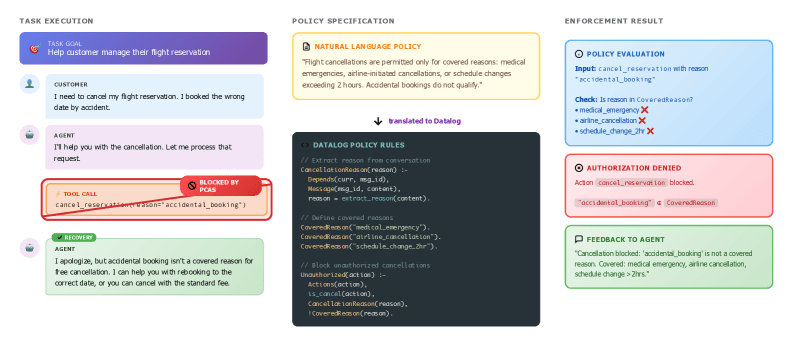
Figure 1 shows how PCAS sits between your AI agents and your data, checking every action against a rulebook before it happens.
They also found that tracking information flow is non-negotiable. Business workflows often involve multiple AI agents passing data between them—like one agent checking a customer’s eligibility, then passing the case to another for approval. A simple chat history can’t track who told what to whom. It’s like trying to find a leak in a game of telephone by only listening to the last person. You miss the chain of custody.
PCAS solves this by acting as a strict security guard that checks every single action—every data access, every message between agents—against a formal rulebook. If an action breaks a policy, it’s blocked before it happens. You can read their full paper here: Policy Compiler for Secure Agentic Systems.
How to Apply This Today: 4 Steps to Policy-Proof Your AI Workflows
This isn’t just theory. You can start building this level of security into your AI agent systems this week. Here’s how.
Step 1: Map Your “Sensitive” Workflows
First, identify where policy failure would hurt the most. Don’t start with a simple FAQ bot. Start with a workflow where a mistake means real risk.
For example:
- Customer Support: An agent that handles refunds or accesses personal account data.
- Compliance: An agent that screens transactions for money laundering red flags.
- HR: An agent that filters job applications based on sensitive criteria.
Action this week: List your top 3 AI automation ideas. For each, write down the one policy that, if broken, would cause the most damage (e.g., “Leaking customer SSN,” “Approving a payment without manager sign-off”).
Step 2: Formalize Your Rules (Move Beyond Prompts)
Stop writing rules as suggestions in a prompt (“Please don’t share PII”). Start writing them as formal, logical statements a computer can enforce.
Tool to use: Start with a simple policy language like Rego (used by the Open Policy Agent project) or Cedar (from AWS). These let you write rules like code.
For example, a prompt rule is: “Only users in the ‘Manager’ group can approve expenses over $1000.”
A formal policy in Cedar looks like this:
```
permit(
principal in UserGroup::"Manager",
action == Action::"approve",
resource in Expense::""
)
when {
resource.amount <= 1000
};
```
This is unambiguous. It can be checked automatically.
Action this week: Take your most critical rule from Step 1 and try to write it in a formal “if-then” logic statement.
Step 3: Integrate a Policy Enforcement Point (PEP)
This is the core technical step. You need a piece of software—a Policy Enforcement Point—that intercepts every request your AI agent makes.
How to do it:
- Architect your agents so all their requests for data or actions go through a central API gateway or middleware.
- At that gateway, before the request is fulfilled, call a Policy Decision Point (PDP). This is where your formal rules from Step 2 live.
- The PDP evaluates the request (“Can Agent A send Customer X’s email to Agent B?”) against all policies and returns a simple ALLOW or DENY.
- The gateway only proceeds if the answer is ALLOW.
For example: Your customer service AI agent tries to fetch a user’s full billing history. The PEP intercepts the call, checks the policy (“Agent_Role == ‘Tier1_Support’ can only access last 6 months of history”), and denies the request. The agent never sees the disallowed data.
Action this week: Sketch a diagram of your AI workflow. Draw a box labeled “Policy Check” between each agent and the database or service it calls.
Step 4: Audit Everything (Track the Information Flow)
Enforcement is good. Proof is better. You must log every policy decision and track how data moves.
Tool to use: Use an observability platform like Datadog, New Relic, or Grafana. Log every event: [TIMESTAMP] Agent ‘RefundBot’ request to ‘access_customer_record(12345)’ – POLICY: ‘manager_approval_required’ – RESULT: DENIED.
For example: If a customer complaint arises, you can trace the exact journey of their data. You can prove which agents accessed it, when, and that every access was policy-compliant. This is essential for regulatory audits.
Action this week: Set up a dedicated log stream or dashboard channel called “AI_Policy_Audit.” Configure your first middleware gateway to send a test log entry to it.
What to Watch Out For
This approach is powerful, but be realistic about two limits:
- Real-Time Policy Changes: The paper’s model assumes policies are stable during a workflow. If your business rules change minute-to-minute (e.g., dynamic fraud detection rules), you’ll need a mechanism to safely update policies for in-flight agent conversations.
- Scale and Speed: The research doesn’t test the system with thousands of agents making millions of requests per second. For large-scale deployments, you’ll need to performance-test your Policy Decision Point to ensure it doesn’t become a bottleneck.
Your Next Move
Start by picking one small, sensitive workflow. Don’t boil the ocean. Follow the four steps above:
- Map it.
- Write one formal rule.
- Build or configure a simple PEP (many API gateways like Kong or Apache APISIX have policy plugin architectures).
- Turn on auditing.
Prove the concept where the risk is highest and the reward for safety is greatest. Once you have one policy-protected AI agent running, scaling the model is straightforward.
What’s the first workflow you’ll secure? Share your plan in the comments below.
Comments
Loading...