
How to Serve Premium AI Customers Without Wasting Expensive GPU Time
You're paying for expensive AI hardware, but your best customers still wait too long.
When a long request from a standard user blocks a high-priority enterprise query, you face a tough choice. You can interrupt the long job, wasting valuable compute cycles. Or you can let the premium customer wait, risking missed service guarantees.
This forces teams to buy more GPUs than they need, just to handle these priority spikes. It's an inefficient tax on your AI infrastructure.
What Researchers Discovered
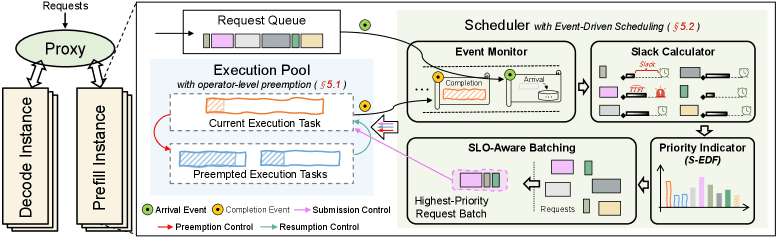
Researchers from Tsinghua University found a smarter way to schedule AI requests. Their method, called FlowPrefill, decouples two critical decisions: when to interrupt a request and how finely to break it down for processing.
Think of it like managing a busy highway. Current methods (chunked prefill) are like closing all lanes to let an ambulance pass. It works, but it stops all traffic. FlowPrefill is like opening a dedicated emergency lane. The ambulance gets through faster, and regular traffic keeps moving.

This separation is the key breakthrough. The paper, FlowPrefill: Decoupling Preemption from Prefill Scheduling Granularity to Mitigate Head-of-Line Blocking in LLM Serving, shows this technique significantly reduces delays for high-priority requests during the initial processing phase (prefill).
Why you should care: This isn't just an academic exercise. It's a direct path to higher profit margins. You can meet strict service-level objectives (SLOs) for premium customers without buying extra hardware. The research indicates this approach can be implemented within existing serving systems.
How to Apply This Today
You don't need to wait for a vendor to implement this. Your team can start applying these principles now. Here are four concrete steps.
1. Audit Your Current Request Patterns and SLOs
First, understand what you're dealing with. You can't manage what you don't measure.
- Action: Instrument your LLM serving stack (e.g., vLLM, TensorRT-LLM, Triton) to log request lengths, arrival times, and associated priority tiers. Use this data to build a picture like the one in the research. PAYLOAD_UPLOAD_67
- For example: Tag all requests from your "Enterprise Platinum" tier. Track how often a long, low-priority request (like a 10k-token document summary) arrives just before a short, high-priority query (like a 50-token customer support answer).
- Effort: 1-2 weeks for a senior engineer. Use open-source observability tools like Prometheus and Grafana.
2. Implement a Priority-Aware Request Queue
Your load balancer or API gateway must understand priority. A simple FIFO queue won't work.
- Action: Modify your request routing logic. Implement a multi-level queue system. Incoming requests are placed into queues based on their customer tier or SLO. A scheduler then pulls from the highest-priority non-empty queue.
- For example: Using a framework like Redis, create three queues:
priority_critical,priority_standard,priority_batch. Your scheduler always checks thecriticalqueue first. - Tools: This can be built with Redis Sorted Sets, Apache Kafka with priority topics, or custom logic in your API gateway (e.g., NGINX, Envoy).
3. Design "Preemption Points" in Your Serving Engine
This is the core technical step. You need to define safe points where a low-priority request can be paused.
- Action: Analyze your model serving engine. Identify natural execution boundaries. The research suggests checking at the chunk or layer level within the prefill phase. PAYLOAD_UPLOAD_68
- For example: If you're using vLLM, you would modify the scheduler to, after completing a processing chunk for a low-priority request, check the high-priority queue. If a job is waiting, you pause the low-priority job, save its state, and switch context to the high-priority one.
- Key: The granularity of these preemption points is separate from your processing chunk size. This is the "decoupling" that makes FlowPrefill efficient.
4. Test with a Staged Rollout and Measure TTFT
Never deploy a major scheduling change all at once.
- Action: Create a canary deployment. Route 5-10% of your production traffic, including a mix of priority tiers, through the new scheduling system. Measure the key metric: Time-To-First-Token (TTFT) SLO violations for your high-priority tier. PAYLOAD_UPLOAD_66
- For example: Your SLO might state that "99% of Platinum requests must receive their first token within 500ms." Compare the violation rate between the old system and the new canary. The goal is to see a sharp drop for premium requests with minimal impact on standard request throughput.
- Success Metric: A reduction in TTFT SLO violations for your top-tier customers by 50% or more, with less than a 5% throughput degradation for lower-tier requests.
What to Watch Out For
This approach is powerful, but it has limits. Be aware of these three points.
- It Optimizes Prefill, Not Generation. FlowPrefill specifically addresses bottlenecks in the initial request processing phase. Long output generation (decoding) can still be blocked by other long generations. You'll need a separate strategy for that phase.
- Added Complexity for State Management. Pausing and resuming requests requires carefully saving and loading the computational state. This adds engineering complexity and a small memory overhead. Test for memory leaks.
- Workload Dependency. The benefits are greatest when you have a mix of long low-priority and short high-priority requests. If all your requests are similar, the gains will be smaller. Know your workload.
Your Next Move
Start by executing Step 1 this week. Have your lead engineer run a one-week trace of your production LLM traffic. Categorize requests by length and customer tier. Plot the distributions.
This data will tell you if head-of-line blocking is a real cost driver for you. It will also give you the baseline you need to prove the ROI of implementing a smarter scheduler.
How much GPU time are you currently wasting on context-switching inefficiency? Share your estimate in the comments.
Comments
Loading...