Stop Guessing About Your Network's Energy Bill: The Tool That Shows You Exactly Where the Waste Is
You’re deploying Open RAN to cut costs and improve sustainability. The promise is there: more flexible hardware, vendor competition, and software-driven control. But you’re missing a critical piece. You can’t see how much energy each component of your new network actually uses. Without that data, you’re making optimization decisions in the dark. Your electricity bill stays high, and your carbon targets slip further away.
What Researchers Discovered
A team of researchers tackled this exact problem. They built a tool called TENORAN that automatically profiles energy consumption in Open RAN systems. You can read their full paper here: TENORAN: Automating Fine-grained Energy Efficiency Profiling in Open RAN Systems.
Think of it like this: moving to Open RAN gives you a smart thermostat for every room in your network building. But to actually save on heating, you first need accurate thermometers in each room. TENORAN installs those thermometers—automatically.
The core challenge is complexity. An Open RAN network has diverse equipment from different vendors, spread across countless sites. Manually measuring the power of every Radio Unit, server, and software function is impossible at scale. It's like trying to track the exact electricity use of every appliance in thousands of homes, all at once.
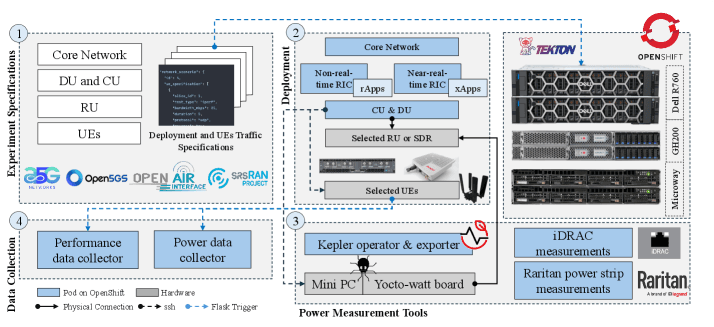
TENORAN solves this by automating the entire profiling process. It connects to your network, collects detailed power and performance data from each piece, and creates a unified report. This gives you the foundational data you’ve been missing.

Figure 1: The TENORAN system automatically collects the detailed data you need, from the Radio Unit (RU) to the software pods in the cloud.
How to Apply This Today
You don't need to wait for a finished commercial product. The research provides a blueprint you can start using now. Here are four concrete steps to implement this level of energy visibility in your own network operations.
1. Build Your Measurement Foundation
First, stop relying on high-level facility power meters. You need to instrument key network elements with granular power sensors.
Action: For your lab or pilot Open RAN sites, deploy hardware power meters like the Yocto-Watt (used in the research) on critical components. Focus on:
- Radio Units (RUs): Measure power under different load conditions.
- Compute Servers: Profile the power draw of your Centralized Unit (CU) and Distributed Unit (DU) software.
- Core Network & xApp Pods: Instrument the cloud infrastructure running your network functions.
For example: Attach a meter to a test RU. Run a script that varies the traffic load from 0% to 100% while logging the power readings. You’ll get a curve showing exactly how power consumption scales—data you’ve never had before.

2. Automate Data Collection with a Central Pipeline
Manual data collection won't scale. You need a system that automatically pulls data from all your sensors and software APIs.
Action: Design a simple data pipeline. Use a lightweight message broker (like MQTT) or a time-series database (like InfluxDB) as the central collection point. Write small agents (Python scripts are fine) that run on your servers or a dedicated collector to:
- Poll the hardware power meters.
- Query performance counters from your RAN software (e.g., srsRAN, OAI) and Kubernetes pods.
- Tag every data point with the component name, location, and timestamp.
Effort: A small team of 2-3 engineers can build this core pipeline in 4-6 weeks for a pilot deployment.
3. Create Component-Specific Energy Profiles
Raw data is useless. You need to turn it into actionable profiles that show how each part of your network uses energy.
Action: Analyze your collected data to build two key profiles for each component type:
- Base Power: The energy used when the component is on but idle (e.g., a cell with no connected users).
- Load-Dependent Power: How much additional energy is used per unit of traffic or processing.
For example: The research showed that a core network User Plane Function (UPF) pod has a high base power. Its energy use doesn't increase much with light traffic, but it scales under heavy load. Knowing this profile tells you that to save energy on the UPF, you should consolidate functions or shut down idle pods—not just reduce traffic.

4. Integrate Profiles into Your RIC for Action
The final step is to feed this energy intelligence into your control systems so you can automate savings.
Action: Feed your component energy profiles into your RAN Intelligent Controller (RIC). Develop simple rApps or xApps that use this data to make decisions.
For example: Build an xApp that reads traffic forecasts and your RU energy profiles. During predicted low-traffic periods (like 2 AM), the xApp can instruct the RIC to power down certain carrier frequencies or put RUs into a deeper sleep state, knowing exactly how much energy will be saved.

What to Watch Out For
This approach is powerful, but be aware of its current limits.
- Measurement, Not Magic: TENORAN and this blueprint provide the critical data. They don't automatically optimize your network. Turning profiles into energy-saving actions is a separate engineering task for your team or your RIC applications.
- Hardware Diversity: Your energy profiles will be specific to your vendor's RU or your server model. A profile for a Foxconn RU won't directly apply to a Dell server running DU software. You must profile your own equipment.
- Savings Are Scenario-Dependent: The research doesn't promise a universal "30% savings" figure. Your actual cost reduction depends entirely on your network's traffic patterns, hardware, and how effectively you use the data to drive automation. The value is in moving from blind guessing to precise control.
Your Next Move
Start by instrumenting one thing. This week, take a single Open RAN test node or lab setup and attach a power meter to it. Run a basic load test and graph the power consumption against the traffic.
You will immediately see the relationship you’ve been missing. That one graph becomes the proof point to secure resources for building a full-scale automated profiling system. How much power is your network wasting right now while you wait?
Comments
Loading...