How to Make Your Warehouse Robots Think for Themselves (Without Rewriting Code)
Your robots are stuck. They can move boxes. They can follow a pick list. But the moment something unexpected happens—a product is out of place, a sensor reading is off, a step fails—everything stops. A human has to step in, reset the system, and restart the process.
This brittleness is the single biggest barrier to automating complex tasks like custom kitting, mixed-SKU packing, or delicate assembly. You end up with expensive machines that only work in perfect conditions, requiring constant supervision.
What if you could give those same robots the ability to reason through problems, adapt their plan, and recover from errors on their own? New research shows you can. And the method is surprisingly straightforward.
What Researchers Discovered: The Power of "Thinking Out Loud"
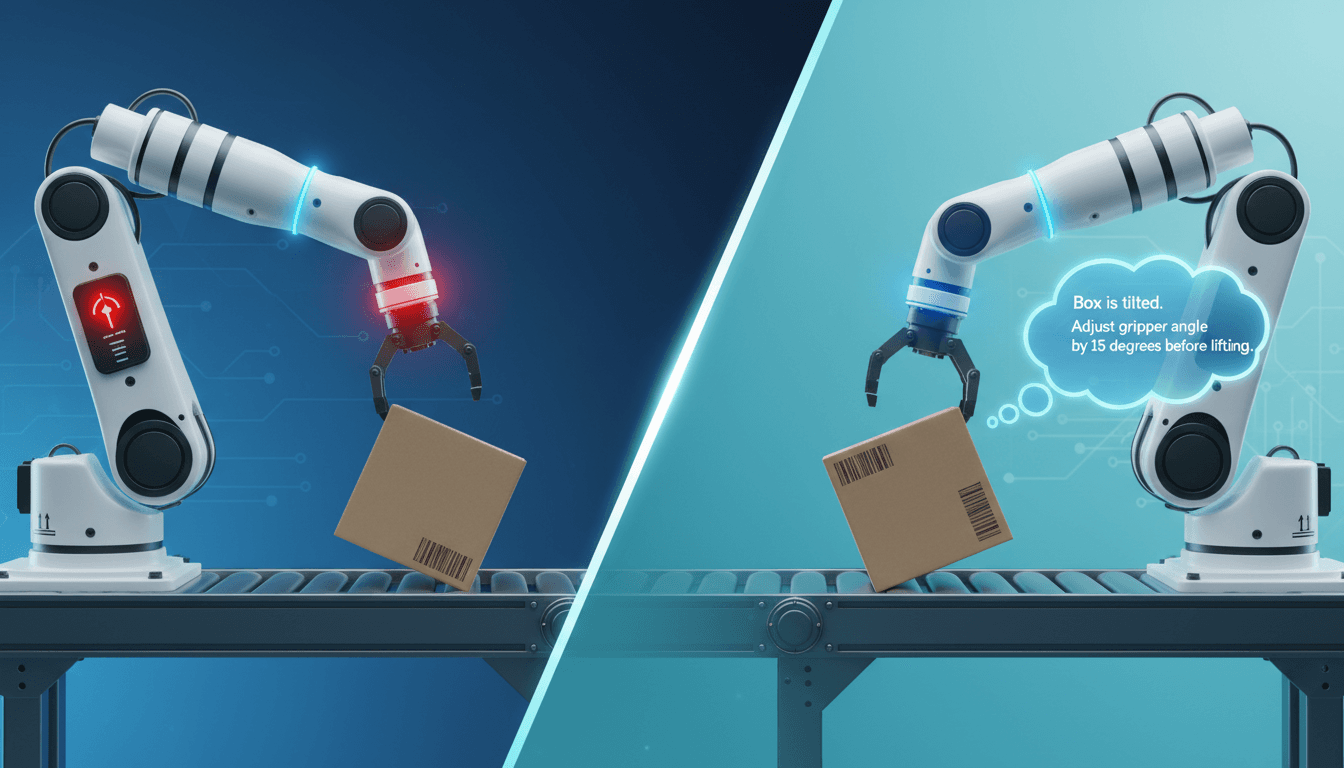
A team from UC Berkeley and Google developed a system called R³ (Robust Reasoning via Reinforcement Learning). Their core finding is simple: When a robot's AI "brain" writes out its reasoning in plain English before acting, its success rate on complex tasks dramatically improves.
You can read the full paper here: R^3: Training Robots to Reason in Natural Language via Reinforcement Learning
Think of it like this. A worker packing a grocery order doesn't just grab items. They think: "The eggs need to go on top, but the cereal box is in the way. I'll move the cereal to the side first, then place the eggs, then surround them with soft items." That internal monologue guides deliberate, correct actions.
The researchers taught a robot's Vision-Language Model (its "brain") to do the same thing. Before sending a command like "move the red block," the AI first generates a reasoning step: "Goal: stack red on blue. The blue block is visible but too far left. I will first move the blue block to the center to make stacking easier."
This "thinking out loud" delivered measurable results:
- It enabled recovery from errors. If the robot's gripper slipped, it could reason about the new state and adjust its plan.
- It made training scalable. The system learned from two kinds of data: a small set of high-quality "reasoning examples" and a large pool of standard action logs.
- The benefit was real-time. Turning off the reasoning during operation made performance worse. The act of explaining during the task itself was crucial.
In essence, they moved from robots that blindly execute steps to robots that build and follow a logical plan.
How to Apply This to Your Operations in 90 Days
This isn't a lab-only concept. The training method is designed for practical implementation. You don't need to start from scratch or replace your existing robotic arms. You add a "reasoning layer" on top of your current systems.
Here is your 5-step implementation plan.
Step 1: Audit Your Existing Data Assets
You need two types of data to train the reasoning model.
- High-Quality "Reasoning" Data (Small Set): This is your gold-standard examples. It can come from:
- Video logs with operator narration. Record a skilled worker performing a complex task while they verbalize their thought process. ("I'm placing the circuit board flat because the connectors are on top. Now I'm selecting the 5mm screw because the spec sheet calls for it.")
- Failed attempt logs. Even failed robot runs are valuable if you can annotate why they failed. ("Gripper missed the component because it was occluded by the cable.")
- Simulation data. Tools like NVIDIA Isaac Sim can generate thousands of synthetic scenarios with perfect reasoning annotations.
Target: Start with 100-500 of these high-quality reasoning examples for your target task.
- Large-Scale Action Data (Bulk Set): This is the data you likely already have.
- Historical robot execution logs. Every time your robotic arm completes a pick-and-place, that's a data point.
- Warehouse management system (WMS) transaction logs. These log what should have been done (e.g., "Pick Item A123 from Bin B7").
- Video feeds from stationary cameras. These show successful task completions without explanation.
Target: Aim for 10,000+ of these action-only logs. The system uses this bulk data to refine the reasoning model at scale.
Step 2: Select and Fine-Tune Your Core AI Model
You will use an open-source Vision-Language Model (VLM) as the robot's new "reasoning brain."
- Model Choice: The research used the Qwen-VL model. This is a strong, publicly available starting point. Alternatives include LLaVA or Fuyu-8B. Choose one based on your team's familiarity and computational constraints.
- Two-Stage Fine-Tuning:
- Stage 1 (Reasoning Foundation): Fine-tune the VLM on your small set of high-quality reasoning examples (from Step 1). This teaches it how to think about your specific tasks.
- Stage 2 (Alignment at Scale): This is the scalable trick. Use your large pool of action data. For each successful action sequence, you have the AI generate multiple possible reasoning paths. Then, you use a second, off-the-shelf AI model (like GPT-4) as a "judge" to score which reasoning path best leads to the known, successful action. This reinforces correct reasoning patterns using massive, existing datasets.
Practical Note: This two-stage process means you don't need to manually create reasoning for thousands of examples. You leverage what you already have.
Step 3: Integrate as a High-Level Planner
You are not replacing your robot's low-level motion controller (its "hands"). You are adding a high-level planner (its new "brain").
- Architecture: The new reasoning VLM sits between your task management system (e.g., WMS) and your existing robot control API.
- Flow:
- The WMS sends a goal:
"Pack order #4567 into carton C3." - The robot's camera feeds an image to the VLM.
- The VLM generates a reasoning step (e.g.,
"The shampoo bottle is tall and unstable. I will place it in the corner first against two walls for support."). - The VLM then outputs a simple action command (e.g.,
"Pick shampoo bottle from station A and place it at coordinates (x,y,z) in carton C3."). - Your existing robot controller executes that precise movement command.
- The loop repeats for the next step.
- The WMS sends a goal:
This keeps your investment in robotic hardware and low-level software intact. You are upgrading the decision-making layer.
Step 4: Start with a Contained Pilot
Do not attempt to roll this out across your entire fulfillment center on day one.
- Choose a Pilot Task: Select a single, complex but bounded task where current automation fails. Examples:
- Mixed-SKU Palletizing: Building a stable pallet from 10+ different box sizes.
- Kitting for Assembly: Placing 5-8 specific components into a tray in a precise orientation.
- Returns Processing: Inspecting, sorting, and placing returned items into correct bins.
- Define Success Metrics: Go beyond "success rate." Measure:
- Human Intervention Rate: How often does a worker need to pause/reset the system? Aim for a 50% reduction.
- Task Completion Time: Does reasoning add delay? Is it offset by fewer errors? Benchmark it.
- Generalization: Can it handle 5 new SKUs it wasn't explicitly trained on?
Run this pilot for 4-6 weeks. Collect data, refine the model, and prove the ROI.
Step 5: Establish a Continuous Feedback Loop
The system learns from experience. Build a pipeline to improve it.
- Log All Operations: Record every reasoning step, action command, and success/failure outcome.
- Flag Failures Automatically: Use simple rules (e.g.,
gripper_force_sensor = 0after a pick command) or manual operator tags to identify failures. - Periodic Retraining: Weekly or monthly, add the new failure cases and successful recoveries to your high-quality reasoning dataset. Re-run the fine-tuning process (Step 2).
This turns your robotic system from a static program into a learning asset that gets better the more you use it.
What to Watch Out For
This approach is practical, but it has clear boundaries. Ignoring these will lead to failed pilots.
- It's a Planner, Not a Magician. The system depends on your robot's basic physical capabilities. If your gripper cannot reliably pick up a specific item, no amount of reasoning will fix that. Solve fundamental mechanical issues first.
- Beware of Latency. Generating language takes compute time. For a high-speed pick-and-place line requiring 10 actions per second, the added 100-500ms per step may be prohibitive. This is ideal for complex tasks with cycle times of 10+ seconds per item.
- Generalization is Limited. A model trained on packing electronics will not suddenly know how to weld. It generalizes within a domain (e.g., to new box shapes) but not across domains. Plan to train separate models for majorly different task families.
- Real-World Noise. The research used clean simulations. Your environment has poor lighting, reflective surfaces, and deformed objects (like bags). Your pilot must test robustness to this noise. Budget time for data augmentation in training (simulating shadows, rotations, etc.).
Your Next Move
Start with Step 1: Data Audit. This week, gather your operations manager, robotics engineer, and data lead. Spend one hour answering these questions:
- What is our single most costly "brittle" task that halts automation?
- Do we have video recordings of this task being done successfully?
- Do we have logs of every robotic action command sent in the last 90 days?
Identifying your data assets is the first concrete step toward building a robot that doesn't just act, but thinks. The rest is implementation.
Question for you: What's the one complex task in your facility that, if a robot could handle it reliably, would free up the most skilled human hours? Share it in the comments.
Comments
Loading...