
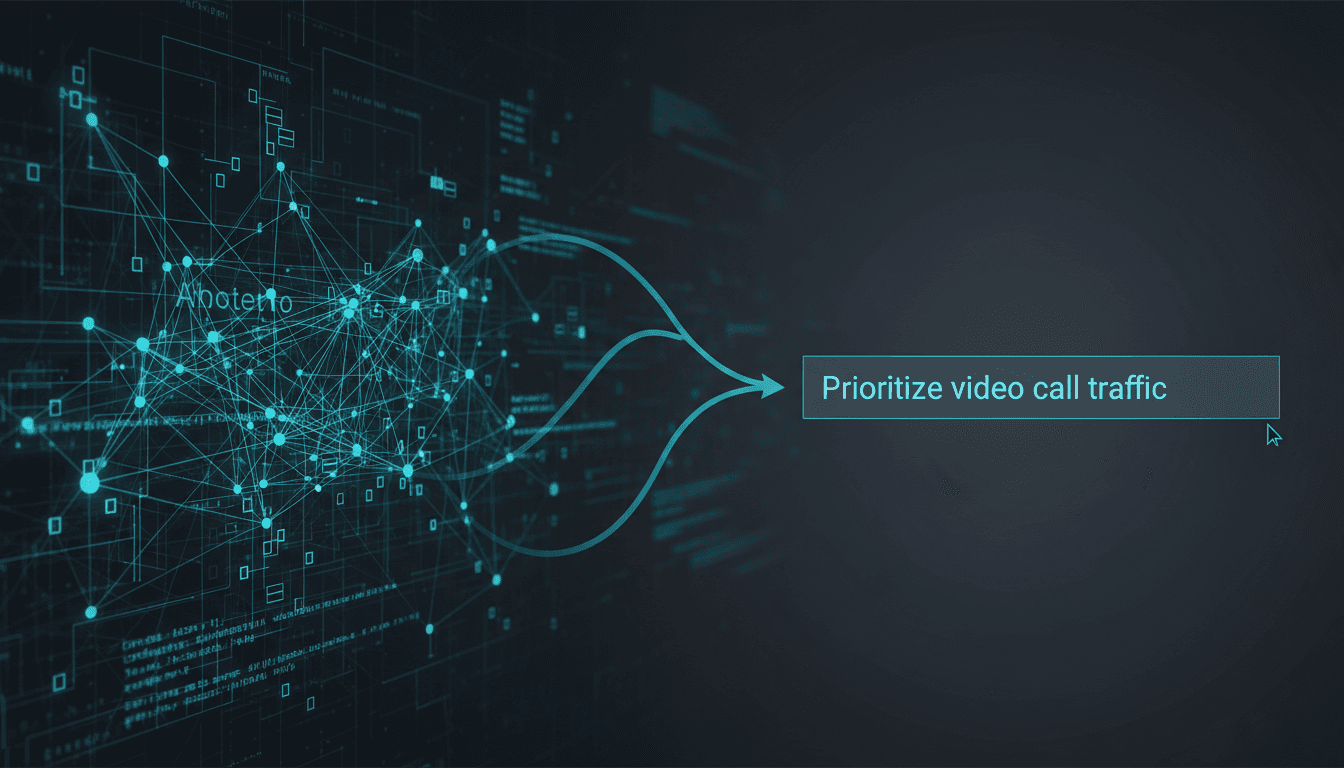
How to Control a Satellite Network with Plain English
You manage a complex network. It could be a data center, a cloud setup, or even a global telecom system. Every time a business unit asks for a new policy—like "prioritize video calls from our Tokyo office"—your team spends hours writing technical rules. It's slow, error-prone, and doesn't scale.
Imagine if you could just type that request in plain English and have the system safely implement it in seconds.
What Researchers Discovered
Researchers at MIT built a system that does exactly that for satellite mega-constellations like Starlink. They proved you can use a Large Language Model (LLM) as a smart translator. It turns complex operator commands into precise network configuration rules.
For example, an operator could type: "reroute financial traffic away from polar links under 80 ms latency." The AI understands this multi-part command and generates the correct technical filters. It beat old, rigid rule-based systems by 46 percentage points on handling complex requests. Validated Intent Compilation for Constrained Routing in LEO Mega-Constellations
But AI alone isn't safe for critical infrastructure. You can't trust its raw output. The researchers' key insight was adding an 8-step validator. This acts like a safety inspector. It checks every AI-generated command for impossible or dangerous conditions before anything touches the live network. In tests, it caught 100% of faulty commands.
They also integrated a specialized routing AI—a Graph Neural Network. This AI makes routing decisions 17 times faster than standard algorithms. It maintains 99.8% delivery performance. Most importantly, it works instantly when new rules are applied. It doesn't need to be retrained for every policy change.
Finally, the system knows the difference between a routing failure and a physical impossibility. If the network's layout makes a request unachievable, it tells you. This stops operators from wasting time trying to fix problems that don't exist.
How to Apply This Today
You don't need a satellite network to use these ideas. The core principle—using AI to safely translate business intent into technical action—applies anywhere. Here are four steps you can start this week.
1. Prototype an LLM as a Configuration Assistant
Start small. Pick a repetitive, rules-based configuration task your team does. This could be setting up firewall rules, cloud security groups, or load balancer policies.
Action: Use an off-the-shelf LLM API (like OpenAI's GPT-4 or Anthropic's Claude) to build a simple prototype. Feed it examples of a business request and the corresponding technical configuration. Prompt it to generate the config for a new, similar request.
For example:
- Input (Business Request): "Block all inbound traffic from IP range 102.130.0.0/16 except for port 443 on our web servers."
- Output (AI-Generated): The prototype should output the exact command-line or configuration file syntax for your specific firewall (e.g., AWS Security Group rules, iptables commands).
Effort: A senior engineer can build this proof-of-concept in 2-3 days.
2. Design Your Validation Layer
This is the most critical step. Never deploy AI-generated configurations directly. You must build a safety checker.
Action: List the failure modes for your chosen task. What makes a configuration dangerous? Common checks include:
- Syntax Validation: Does the output match the required format?
- Semantic Validation: Does the rule make logical sense? (e.g., not blocking all traffic to a critical database).
- Conflict Detection: Does this new rule contradict an existing, higher-priority rule?
- Security Policy Check: Does it violate a company security standard?
For example: If your AI suggests a firewall rule that opens port 22 (SSH) to the entire internet (0.0.0.0/0), your validator should flag this as a high-risk violation and block deployment.
Effort: Design the validation logic first. For a focused task, a team of two can outline the core checks in one week.
3. Integrate a Fast, Adaptive Routing Engine (For Network Teams)
If your work involves dynamic routing (software-defined networks, content delivery), explore specialized AI models.
Action: Investigate Graph Neural Network (GNN) libraries like PyTorch Geometric or DGL. These are designed for network-like data. You can train a model on your network's topology and traffic patterns to predict optimal paths.
For example: Train a GNN model on historical latency data between your global points of presence. The model can then instantly calculate the best route for a video stream when a link fails, much faster than running a traditional shortest-path algorithm.
Prerequisite: This step requires machine learning expertise. Start with a simulation of your network before considering live deployment.
4. Build a Feedback Loop for "Impossible" Requests
Teach your system to recognize when a goal is physically or logically unattainable with the current resources.
Action: When your validator blocks a request, categorize the reason. Create a simple library of "topological constraints" for your system. When a user asks for something impossible, the system should explain why, citing the specific constraint.
For example: A user requests: "Ensure database latency under 1ms for users in Australia." If your nearest server is in Singapore, the system should respond: "Request infeasible due to speed-of-light constraint. Minimum theoretical latency from Australia to your Singapore server is 8ms. Consider deploying an edge location in Sydney."
This builds trust and turns failed requests into valuable infrastructure planning data.
What to Watch Out For
This approach is powerful but has limits. Be honest about them.
- The AI is a translator, not an oracle. The routing GNN needs retraining if your network's fundamental structure changes (e.g., you add a new data center region or satellite orbital plane). Budget for periodic model updates.
- Safety first, speed second. For extremely complex combinations of rules, the research system defaults to a slower, classic algorithm to guarantee safety. Your system should have a similar fallback mode. Do not let the AI make unchecked decisions on critical production systems.
- Simulation vs. Reality. This research was tested in simulation. Real networks have unpredictable chaos—hardware failures, weird bugs, unexpected traffic spikes. Pilot your system in a staging environment that mirrors production complexity before going live.
Your Next Move
This week, try Step 1. Pick one annoying configuration task. Spend a few hours with an LLM API seeing if it can accurately generate the technical output from a plain-language description. You'll quickly learn both the potential and the pitfalls.
The goal isn't fully autonomous AI. It's augmented intelligence—using AI to handle the translation grunt work, while your team focuses on strategy, safety, and oversight. This is how you move from manual, error-prone configuration to intent-based operations.
Question for you: What's the most time-consuming, repetitive configuration task your team handles? Could describing it in a sentence save hours of work?
Comments
Loading...