Automate Strawberry Harvesting: A Proven 84% Success Blueprint
Imagine losing a third of your crop because you can't find enough skilled pickers. Labor shortages and high wages are squeezing farm profits. You need a reliable way to harvest delicate fruit like strawberries, especially in controlled greenhouse environments.
What if you could automate this task with over 84% success? New research shows it's possible. And the method is surprisingly practical. You can start testing it in your operation within a year.
What Researchers Discovered
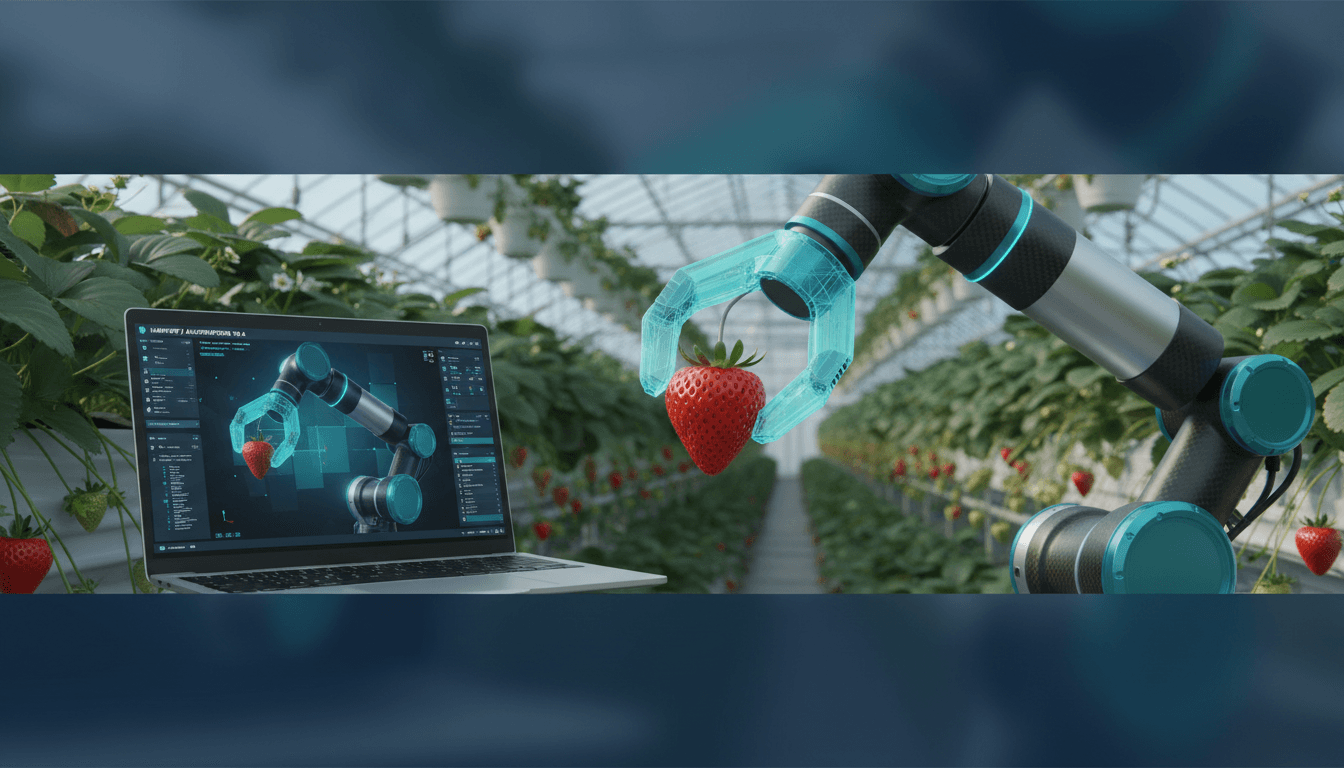
A team built a complete robotic system for picking strawberries in a greenhouse. They achieved an 84.3% success rate in real-world tests. The robot picked 281 strawberries successfully.
Their paper, Robotic Strawberry Harvesting with Robust Vision and Deep Reinforcement Learning based Sim-to-Real Control, details a practical blueprint. It works because of two key innovations.
First, they built a smarter eye for the robot. Standard vision systems get confused by leaves and shadows. Their custom AI model spots and outlines individual strawberries 10-14% more accurately. Think of it like giving the robot reading glasses with a highlighter. It sees the fruit clearly, even when partially hidden.
Second, they trained the robot's arm entirely in a computer simulation. The robot practiced picking millions of times in a perfect digital world. This is like a pilot training in a flight simulator before flying a real plane. It learned smooth, stable motions without damaging a single real strawberry or piece of hardware.
Finally, they connected everything in a closed-loop system. The robot sees, plans, and moves in real time. It constantly adjusts based on what its camera sees. This makes it robust to natural variations in the greenhouse.
How to Apply This Today
You don't need a massive R&D budget to start. You can pilot a similar system in a controlled environment. Here are five concrete steps to begin this week.
1. Start with Simulation, Not Hardware
Do not buy a robot arm yet. Your first investment should be in simulation software. The researchers used NVIDIA's Isaac Lab. This is a realistic virtual playground for robots.
Your action: Download a simulation environment like Isaac Lab or PyBullet. Model your greenhouse layout and strawberry plants in 3D. This is where you will design and test your picking logic for zero cost.
For example: Create a digital twin of one row in your greenhouse. Program a simple virtual arm to reach for a virtual strawberry. This step alone can save you thousands in potential hardware damage during development.
2. Upgrade Your Vision System with a Custom Model
Off-the-shelf object detection (like standard YOLO models) often fails in leafy, cluttered environments. You need a model trained specifically for your crop and setting.
Your action: Use the research as a guide. Their model is called HRAttnEdge-YOLO26-seg. Focus on finding or building a model that excels at instance segmentation. This means it doesn't just find the strawberry; it draws a precise outline around it.
For example: Collect 500-1000 images of your strawberries under different lights and angles. Use a tool like Roboflow to annotate them and train a custom model. Expect this to take 2-3 weeks for a small team. The accuracy gain is worth it.
3. Choose the Right Off-the-Shelf Hardware
Once your simulation and vision are working, select physical components. The researchers used a Universal Robots UR10e arm. This is a common, reliable industrial arm.
Your action: Partner with a robotics integrator. Specify you need:
- A 6-axis collaborative robot arm (like UR or Fanuc).
- A simple, soft gripper designed for delicate fruit.
- A high-resolution RGB-D camera (like an Intel RealSense).
Buying standard components keeps costs predictable and speeds up deployment.
4. Implement Closed-Loop Control with ROS
The robot must react in real time. An open-loop system just follows a pre-programmed path and often misses. A closed-loop system uses constant camera feedback to guide the arm.
Your action: Build your system on the Robot Operating System (ROS). ROS is the standard framework for connecting sensors, planners, and actuators. It lets your vision software talk directly to your arm controller, creating the adaptive loop you need.
For example: A ROS node runs your vision model. It publishes the strawberry's 3D location. Another ROS node subscribes to that data and calculates the arm's movement path. This happens 10-30 times per second.
5. Run a Focused Pilot in 12 Months
Set a realistic goal: automate harvesting for a single variety in one section of your greenhouse within a year.
Your action: Form a small team (2-3 people) with skills in robotics, computer vision, and your crop science. Dedicate a 100-square-foot test area. Measure everything: success rate, pick speed, and fruit damage. Compare it directly to your manual process.
The researchers' 84.3% rate is a strong benchmark. Aim to match or exceed it in your controlled pilot.
What to Watch Out For
This approach is practical, but it has limits. Be aware of these three challenges.
- Dense Clusters and Hidden Fruit. The system struggled with berries packed tightly together or completely hidden behind leaves. Your vision model will have the same limitation. Plan for a hybrid approach where robots handle the easy-to-reach fruit and humans handle complex clusters.
- Selective Picking for Ripeness. This research focused on picking all fruit. In a real harvest, you need to pick only the ripe berries. You will need to add a ripeness detection module to your vision system, likely using color analysis.
- Economic Speed. The study didn't fully quantify picking speed versus human workers. In your pilot, you must measure cycles per hour. The robot doesn't get tired, but it might be slower initially. The business case depends on 24/7 operation and reduced labor costs.
Your Next Move
Start by exploring simulation. This week, download a free robotics simulator and model one strawberry plant. Get comfortable with the virtual environment before you spend a single dollar on hardware.
This research proves a reliable, automated harvest is within reach. The path is clear: simulate first, see precisely, and use feedback to guide movement.
What's the biggest obstacle you face in automating delicate tasks like this? Share your challenge, and let's discuss practical solutions.
Comments
Loading...